9:00
Reference Image
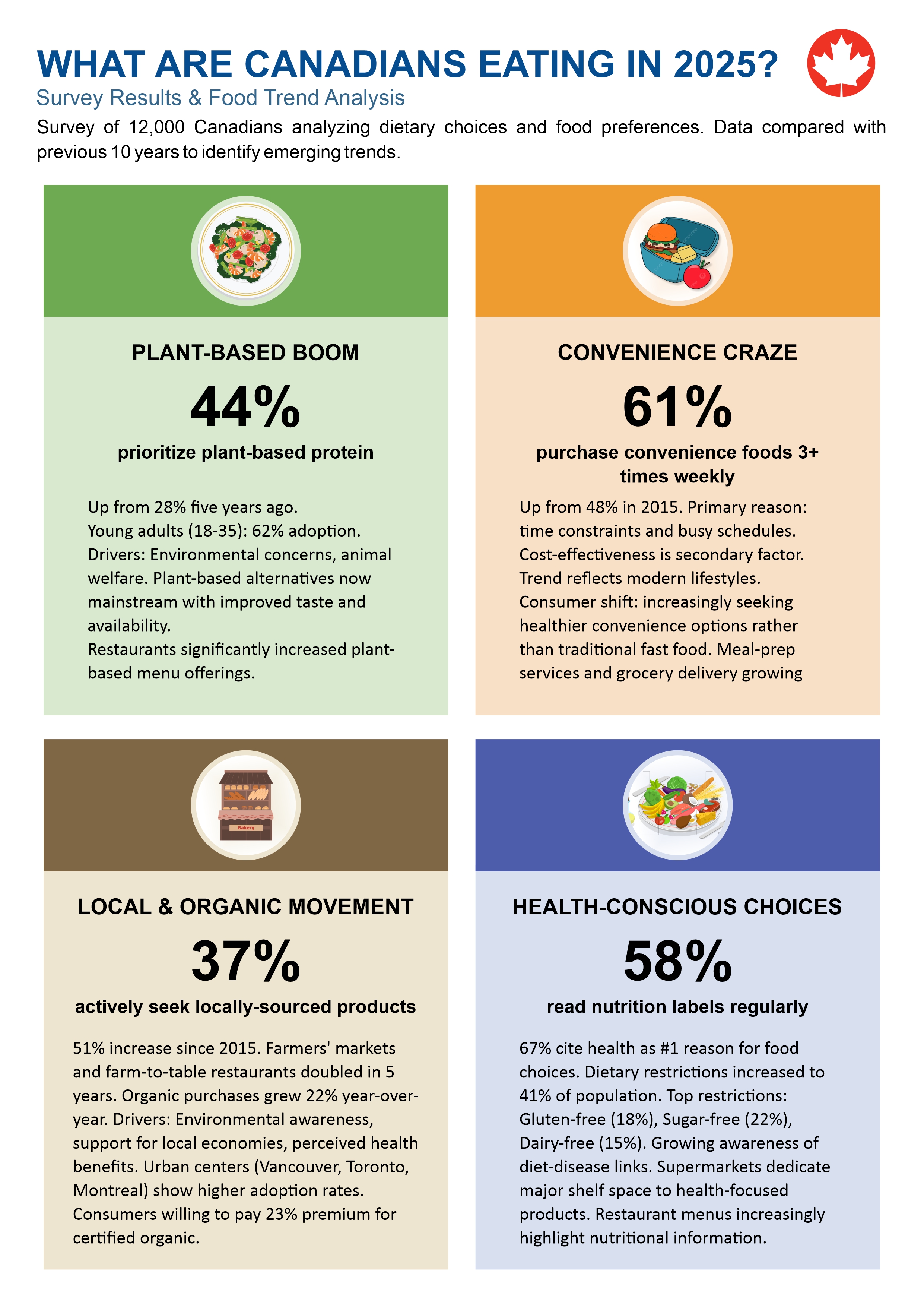
Read the following email message about the diagram on the left. Complete the email by filling in the blanks. Select the best choice for each blank
From: Dr. Elena Martinez
To: James
Subject: Food Trends Survey Results - Key Findings
Hi James,
I wanted to share findings from our survey of 12,000 Canadians on food preferences in 2025. The results reveal important shifts in eating habits.
The most striking trend is 1..... About 44% of Canadians now prioritize plant-based proteins, up from 28% five years ago. Young adults (18-35) are leading this shift at 62% adoption, driven by environmental and ethical concerns.
Interestingly, 2.... remains equally dominant. Over 61% purchase convenience foods three or more times weekly. The key difference is consumers increasingly seek healthier convenience options rather than traditional fast food.
On the positive side, 3.... is gaining momentum. We found 37% actively seek locally-sourced products—a 51% jump since 2015. Farmers' markets and farm-to-table restaurants have doubled in number.
Another critical finding is 4..... Approximately 58% of Canadians regularly read nutrition labels. Most significantly, 67% cite health as their #1 reason for changing food choices.
We identified several dietary restrictions, with 5.... being most common at 18%, followed by sugar-free (22%) and dairy-free (15%).
What surprises me most is that 6.... no longer seems to be a limiting factor. Many consumers willingly pay 23% more for certified organic products, suggesting values around health and environment outweigh budget concerns.
These trends have clear implications for our nutrition counseling practice. Would love to discuss how we can help clients navigate these changing food landscapes.
Best,
Dr. Elena
I wanted to share findings from our survey of 12,000 Canadians on food preferences in 2025. The results reveal important shifts in eating habits.
The most striking trend is 1..... About 44% of Canadians now prioritize plant-based proteins, up from 28% five years ago. Young adults (18-35) are leading this shift at 62% adoption, driven by environmental and ethical concerns.
Interestingly, 2.... remains equally dominant. Over 61% purchase convenience foods three or more times weekly. The key difference is consumers increasingly seek healthier convenience options rather than traditional fast food.
On the positive side, 3.... is gaining momentum. We found 37% actively seek locally-sourced products—a 51% jump since 2015. Farmers' markets and farm-to-table restaurants have doubled in number.
Another critical finding is 4..... Approximately 58% of Canadians regularly read nutrition labels. Most significantly, 67% cite health as their #1 reason for changing food choices.
We identified several dietary restrictions, with 5.... being most common at 18%, followed by sugar-free (22%) and dairy-free (15%).
What surprises me most is that 6.... no longer seems to be a limiting factor. Many consumers willingly pay 23% more for certified organic products, suggesting values around health and environment outweigh budget concerns.
These trends have clear implications for our nutrition counseling practice. Would love to discuss how we can help clients navigate these changing food landscapes.
Best,
Dr. Elena